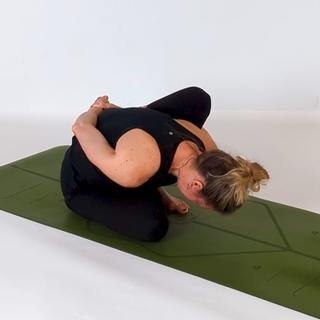
Sitting with legs extended, bend the left knee and bring the left foot to rest on top of the upper right thigh with the sole of the foot facing upward (Half Lotus).
Bend the right knee and bring the right foot back to place it near the right hip bone (as in Sitting bound one-leg forward fold) without letting the right knee drop over to the right, or the lotus foot slide out.
Bring one or both hands behind the hips to help you fold forward, OR take one or both hands forward to reach into the forward fold with the right leg and the left foot as a foundation.
From there, rotate the right arm internally as you wrap it around the right shin and take the hand behind the back.
Bring the left hand back to meet it and grasp the fingers or hands to create a bind.
Lower the head toward the floor and gaze toward the tip of the nose.
Take 5 breaths.
Then unfold and repeat on the other side - right leg in half lotus and left leg bent with the foot flat.
Form tips
This is an external rotation for the hip that is in half lotus, and an internal rotation for the bent leg with the foot down.
Tuck the half lotus foot securely into the hip crease before bending the other leg. Only bend that leg as far as is comfortable for the lotus ankle, knee and hip.
You’re trying to come forward enough that the foot and opposite thigh are the foundation of the posture, which means the lotus leg has to rotate externally even more. If it won’t go, DO NOT FORCE IT. This will put pressure on the knee rather than the hip, and potentially cause pain or harm.
It is quite common and normal for the bent leg hip to raise off the floor as you fold forward.
Focus on hinging at the hip to come forward rather than rounding the back.
This is also a strong bind for the shoulders.
The shoulder must be in front of the shin before reaching back for the bind. Otherwise there will be pressure on the shoulder joint that may cause pain
injury.
For tight shoulders, you could use a strap to make up the distance between the hands.