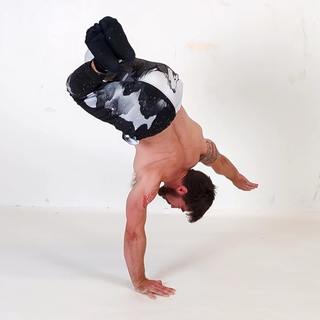
The Tuck one-arm handstand has two main variation: the flag version and the upright version. The flag variation is very heavy on the obliques and requires more strength, while the upright version requires more technique and body awareness. The more upright version of the Tuck one-arm handstand requires a slight rotation of the hips in the direction of the support arm. The torso will also follow this twist, creating a slight angle between the chest and base hand compared to the Straddle one-arm handstand and the One-arm handstand . In this position, the shoulder may appear or feel closer to the chin, as opposed to the ear in the other positions.
In addition to pushing the hand into the floor to elevate the shoulder of the base arm, remember to keep squeezing the knees and ankles together to keep the lower body rigid. Actively pull the thighs towards the ribs in the upright tuck variation or lower the side of the thigh towards the ribs in the flag variation.
Try to keep the weight on the inside of the hand, around the thumb and index finger, as opposed to dumping weight into the outside blade of the hand. Too much weight in the outside part of the hand increases the risk of injuries.
The Abs should be braced enough to accept a light slap on the stomach without pain, but not maximally squeezed.
Some people may find the Tuck one-arm handstand easier than the Straddle one-arm handstand .