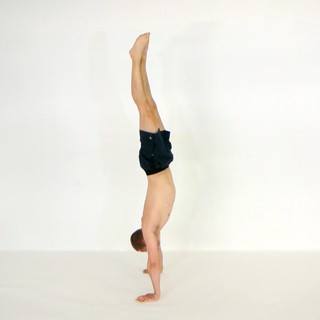
There are multiple ways to get into the Handstand : you can balance off the wall, you can jump straight into it, you can press into it from the ground, or you can split your legs. That last one is generally easier. To do that, place your hands on the ground, lift one leg up, and jump off the other one, then slowly bring the legs together at the top.
To be able to balance, you will need to dig your fingertips into the ground, so that your center of mass is on a line somewhere between your wrists and your fingertips.
When making several attempts at balancing, only log one set when you manage to find the balance point for at least a few seconds; if you don't manage to balance and fall, do not log the set. If you have too much difficulty finding the balance, do work on the wall ( Back-to-wall handstand or Chest-to-wall handstand ).
Balancing a handstand is a long journey and it takes many people years of practice to get it; if you keep at it, you too can achieve it!
Form tips
In the standard Handstand , your body is forming a straight line from toes to hands. This requires opening the shoulders (180 degrees Shoulder flexion backward ), maintaining a posterior Pelvic tilt and activating the Abs ("sucking the bellybutton in").
It can also help to squeeze the legs together and point the toes, to create full body tension.
Risks
Make sure you are comfortable falling before attempting this exercise without a wall. When falling because of overbalancing (too much weight forward), the easiest way to get out is to "pirouette", which is done by moving one hand forward (generally your dominant hand), and do a motion resembling a cartwheel.
Make sure your can hold your weight up before attempting, to avoid falling head first on the ground. A 30 seconds-long Back-to-wall handstand is necessary.
As with most handbalancing exercises, this creates a lot of tension in the wrists - make sure they are well warmed up before practicing, to avoid getting hurt.